Opening a Hair Salon in Switzerland: Qualifications, Costs and Complete Guide (2026)
The hairdressing profession is one of the most traditional and most heavily regulated professions in the Swiss beauty and wellness sector. If you want to open your own hair salon in Switzerland, you need to navigate not just business registration, but also qualification requirements, the generally binding national collective labor agreement (L-GAV), cantonal permits, and industry-specific regulations. This makes the entry more demanding than in many other beauty professions, but also more structured and predictable.
In this comprehensive guide, you will learn everything you need to know in 2026 to open your own hair salon in Switzerland: from training and qualifications to legal structure, costs, and client acquisition. Whether you plan to rent a full salon or start with a chair rental arrangement, you will find the answers here.
Training and Qualifications: EFZ and Beyond
The standard qualification in the hairdressing profession is the Federal Certificate of Proficiency (EFZ, Eidgenössisches Fähigkeitszeugnis) as a hairdresser (Coiffeuse/Coiffeur). The apprenticeship lasts three years and follows the Swiss dual education system: you work in a training salon while attending vocational school. During the apprenticeship, you receive an apprentice salary (approximately CHF 600 in the first year up to about CHF 1,400 in the third year).
After completing your EFZ, several advanced qualifications are available:
- Federal Professional Examination (Berufsprufung/BP) with Federal Diploma of Higher Education: The BP deepens your technical and business management skills. It is the first level of advanced vocational training and qualifies you as a specialist in the hairdressing profession. The federal diploma (eidg. Fachausweis) is highly regarded in the industry and provides a solid foundation for running your own salon.
- Advanced Federal Professional Examination (Hohere Fachprufung/HFP) as Master Hairdresser (Coiffeurmeister:in): The highest level in the profession. With the master diploma, you have comprehensive entrepreneurial and technical competencies. You are qualified to manage a larger business, train apprentices, and actively shape the industry.
- Specialization courses: Color techniques, hair extensions, beard grooming, bridal styling, and other areas offer you the opportunity to stand out from the competition.
Important: Strictly speaking, you do not legally need an EFZ to open a hair salon in Switzerland. Unlike in Germany, there is no general requirement to hold a master craftsman qualification (Meisterpflicht). So in theory, you could operate a salon without formal training. However: Without an EFZ, you may not call yourself "Coiffeuse/Coiffeur EFZ." In practice, clients and the industry expect solid professional training. A salon without a qualified professional will struggle to build trust and attract employees. Additionally, without an EFZ and at least three years of professional experience, you are not permitted to train apprentices.
The L-GAV: National Collective Labor Agreement
What sets the hairdressing profession in Switzerland apart from almost all other beauty professions is the L-GAV (Landes-Gesamtarbeitsvertrag), the national collective labor agreement. This agreement was negotiated between the industry association coiffureSUISSE and the trade unions, and has been declared generally binding (allgemeinverbindlich) by the Federal Council (Bundesrat). This means it applies not only to association members, but to all hair salons with employees in Switzerland.
The key provisions of the L-GAV at a glance:
- Minimum wages: With an EFZ, the minimum wage is approximately CHF 4,100 per month (paid 13 times per year). With a federal professional examination (BP/eidg. Fachausweis), this increases to approximately CHF 4,600 per month. These amounts are regularly adjusted, so always check the current figures with coiffureSUISSE.
- 13th month salary: Every employee is entitled to a 13th monthly salary payment. You must factor this into your cost calculations.
- Vacation entitlement: Until the age of 50, employees are entitled to 5 weeks of vacation per year. From age 50 onwards, this increases to 6 weeks.
- Maximum working hours: The weekly working time must not exceed 43 hours.
- Mandatory continuing education: The L-GAV requires mandatory continuing education for employees. As an employer, you must ensure your staff can attend the prescribed courses.
- Enforcement and education contributions: Both employers and employees pay contributions to the joint commission (paritätische Kommission) that oversees the L-GAV.
What does this mean for you? As long as you work as a sole self-employed person, the L-GAV does not directly apply to you. However, as soon as you hire your first employee, you must fully comply with the L-GAV: minimum wages, 13th month salary, vacation regulations, working time rules, and continuing education requirements. This makes staffing costs in the hairdressing sector much more predictable, but also significantly higher than in unregulated beauty professions.
Permits and Regulations
Unlike many other beauty professions, the hairdressing profession in some cantons has specific regulatory requirements:
- Professional practice permit (Berufsausubungsbewilligung): Some cantons require a specific permit to operate a hair salon. The requirements vary significantly from canton to canton. Check early with the responsible cantonal authority (often the Office for Economic Affairs or the Department of Economic Affairs).
- Hygiene standards: Hair salons are subject to strict hygiene regulations. These include the disinfection of tools (scissors, combs, razors), regular cleaning of washing stations and workstations, and proper storage of products.
- Chemical regulations: In the hairdressing profession, you work with chemicals daily: hair dyes, bleaches, perm solutions. Special regulations apply to the storage and disposal of these products. You may need a Safety Data Sheet (SDS/Sicherheitsdatenblatt) for each product and must ensure proper disposal of chemical waste.
- Water and wastewater: Water consumption in a hair salon is high. Make sure your premises have sufficient water connections and that wastewater disposal complies with local regulations.
- Fire safety: Some salon products are flammable. Ensure compliance with fire safety regulations, particularly regarding the storage of aerosols and chemical products.
- Food safety regulations: If you offer beverages or small snacks in your salon (which many salons do), additional requirements may apply depending on the canton.
Legal Structure and Business Registration
As with most self-employment ventures in Switzerland, the sole proprietorship (Einzelfirma) is the simplest and most affordable way to start. You register with the cantonal compensation office (Ausgleichskasse) as self-employed, and once you reach annual revenue of CHF 100,000, registration in the commercial register (Handelsregister) becomes mandatory.
However, in the hairdressing sector, you should consider establishing a GmbH (LLC) early on, especially if you plan to hire employees. Here is why:
- L-GAV obligations: Once you have employees, as a sole proprietor you bear full personal liability for all L-GAV obligations. With a GmbH, liability is limited to the company assets.
- Employer obligations: As an employer, you must arrange UVG (accident insurance), BVG (occupational pension, for annual salaries above CHF 22,050 per employee), and KTG (daily sickness benefit insurance). These costs are substantial and more manageable within a GmbH structure.
- Professional image: A GmbH signals to clients and employees that you are serious about your business.
The key steps for starting your business:
- Create a business plan (concept, target audience, location, financial plan)
- Register with the compensation office (Ausgleichskasse) as self-employed
- Register in the commercial register (Handelsregister) as a sole proprietorship or GmbH
- Check and apply for cantonal permits
- Take out insurance (professional liability, UVG if you have employees)
- Open a business bank account (for a GmbH: capital deposit account)
- Check VAT obligations (mandatory from CHF 100,000 annual revenue)
Cost Overview
The costs for opening a hair salon vary widely, depending on whether you take over an existing salon, set up from scratch, or start with a chair rental arrangement. Here is a realistic breakdown:
| Item | Cost (CHF) |
|---|---|
| Training EFZ (3-year apprenticeship) | Apprentice salary (you earn while training) |
| Hairdressing chairs (2-4) | 1,000 - 4,000 |
| Washing station | 1,500 - 5,000 |
| Mirrors and lighting | 500 - 2,000 |
| Tools (scissors, hair dryer, flat iron, etc.) | 500 - 2,000 |
| Products (initial stock: colors, shampoos, styling products) | 1,000 - 3,000 |
| Salon fit-out and renovation | 5,000 - 30,000 |
| Rent (per month) | 1,000 - 3,500/month |
| Professional liability insurance (per year) | 200 - 500/year |
| Marketing and website | 500 - 3,000 |
| Total minimum (chair rental model) | 3,000 - 8,000 |
| Total own salon (full fit-out) | 20,000 - 60,000 |
The range is wide. A simple salon in a small town with second-hand equipment will be at the lower end. A modern salon in a prime location in Zurich, Basel, or Bern can easily cost CHF 50,000 or more. Chair rental is the most affordable entry point: you rent a workstation in an existing salon and bring your own tools and products. This way, you can start with just a few thousand francs and build up your client base first.
Location and Salon Design
Location is particularly critical in the hairdressing profession. Unlike mobile massage therapists or beauticians who can visit clients at home, hair salons rely on walk-in traffic (Laufkundschaft). A good location with high foot traffic, strong visibility, and easy accessibility can make the difference between success and failure.
When choosing your location, consider:
- Foot traffic: How many people walk past your salon daily?
- Accessibility: Are there parking spaces or public transport connections nearby?
- Competition density: How many salons already exist in the area?
- Rent relative to potential: An expensive location only pays off if the foot traffic is correspondingly high.
- Infrastructure: Sufficient water connections, electricity (dryers and equipment require a lot of power!), ventilation (due to chemicals), and wastewater facilities.
When designing your salon, you should aim for a cohesive overall concept. Clients typically spend 30 to 90 minutes in the salon, and the ambiance significantly influences whether they return. Pay attention to:
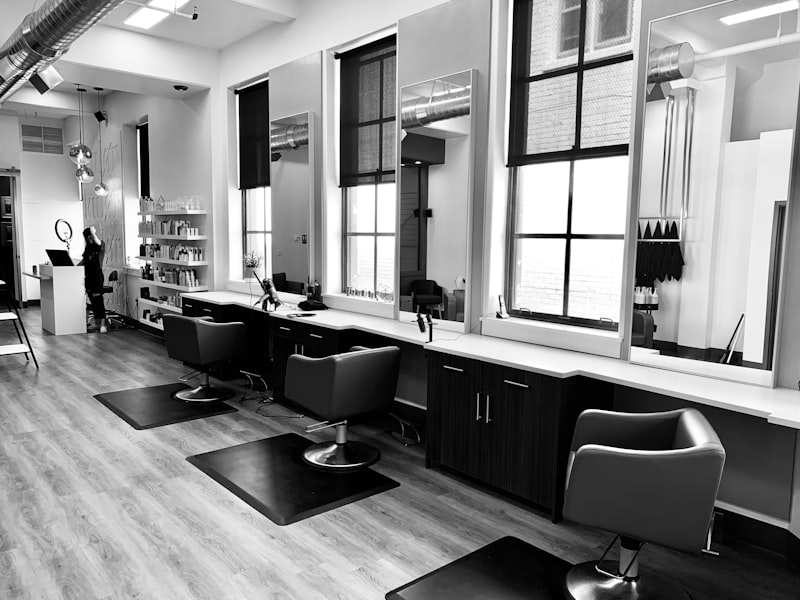
- Clean, modern design: Good lighting (essential for color consultations!), comfortable chairs, attractive mirrors.
- Functional layout: Reception area, washing area, cutting and styling area, possibly a separate area for coloring.
- Waiting area: Comfortable seating, magazines, perhaps beverages.
- Break area for staff: If you have employees, Swiss labor law requires a suitable break room.
Chair rental as an alternative: If you are not yet ready to open your own salon, chair rental (Stuhlmiete) is a popular entry model. You rent a workstation in an existing salon and work as a self-employed professional. The rent typically ranges from CHF 500 to 1,500 per month, depending on location and amenities. You build your own client base without bearing the full financial risk of your own salon.
Hiring Employees and L-GAV Obligations
Once your salon grows and you want to hire employees, you enter the most heavily regulated aspect of the hairdressing profession. The L-GAV sets clear framework conditions that you must follow:
- Comply with minimum wages: Employees with an EFZ receive at least approximately CHF 4,100/month, those with a federal professional diploma (eidg. Fachausweis) at least approximately CHF 4,600/month (each paid 13 times). These minimum wages apply regardless of whether you are an association member.
- Social insurance: AHV/IV/EO (employer and employee contributions of approximately 5.3% each), UVG (occupational accident insurance mandatory, non-occupational accident insurance from 8 hours/week), BVG (from an annual salary of CHF 22,050), ALV (unemployment insurance), FAK (family allowances).
- Daily sickness benefit insurance (KTG/Krankentaggeldversicherung): The L-GAV requires daily sickness benefit insurance. The premiums are split between employer and employee.
- Vacation and working hours: 5 weeks vacation (6 weeks from age 50), maximum 43 hours per week. Overtime must be compensated with time off or paid with a surcharge.
- Continuing education: You must enable your employees to attend the mandatory continuing education courses as prescribed by the L-GAV.
Training apprentices: If you hold an EFZ, have at least three years of professional experience, and have completed the vocational trainer course (Berufsbildnerkurs), you may train apprentices. This is an excellent opportunity to develop new talent according to your own standards. Apprentice wages are significantly lower than the minimum wages (approximately CHF 600 to 1,400 per month), but you invest considerable time in supervision and training.
Marketing and Client Acquisition
A hair salon thrives on regular clients and word-of-mouth referrals. But first, you need to become visible. Here are the most important marketing measures:
- Google Business Profile: Absolutely essential. Most people search for "hairdresser near me" on Google. A complete profile with photos, opening hours, prices, and reviews is your most important marketing tool. It is free.
- Online booking systems: Platforms such as Treatwell, Salonkee, or Planity allow clients to book appointments directly online. This saves you time on the phone and makes your salon accessible around the clock. Costs are approximately CHF 50 to 150 per month, depending on the provider and features.
- Instagram and social media: Show your work! Before-and-after photos, color transformations, styling tips. Instagram is the most important platform for hairdressers. Post regularly and use local hashtags.
- Your own website: A simple, professional website with your services, prices, location, and booking option. It does not need to be expensive, but it must be modern and mobile-friendly.
- Loyalty programs: Stamp cards (every 10th haircut free), referral bonuses, or birthday discounts. Small gestures that retain clients.
- Opening offers: To attract initial clients, you can offer reduced prices or a complimentary service (e.g., free scalp analysis).
Regarding pricing, here are some benchmark figures for Switzerland (as of 2026):
| Service | Price range (CHF) |
|---|---|
| Men's haircut | 45 - 80 |
| Women's haircut (wash, cut, blow-dry) | 80 - 180 |
| Coloring | 150 - 350 |
| Highlights/Balayage | 180 - 400 |
| Beard grooming | 25 - 50 |
| Wedding styling | 200 - 500 |
Prices vary considerably depending on location, experience, and positioning. In Zurich or Geneva, prices tend to be at the upper end, while in rural areas they are lower. Set your prices so that they cover your costs and allow you a reasonable income.
Checklist: Opening a Hair Salon
Here are the key steps at a glance so you do not miss anything:
- Complete your training: EFZ as a hairdresser (Coiffeuse/Coiffeur), ideally supplemented by the federal professional examination (Berufsprufung/BP).
- Gain professional experience: Work in various salons for at least 2-3 years to build experience and a client base.
- Create a business plan: Define your target audience, location, positioning, financial plan, and revenue projections.
- Choose your legal structure: Sole proprietorship (Einzelfirma) or GmbH (LLC), depending on your situation and growth plans.
- Register with the compensation office: Officially register your self-employment with the Ausgleichskasse.
- Check cantonal permits: Clarify professional practice permits (Berufsausubungsbewilligung) and any other requirements.
- Find a location and sign a lease: Pay attention to location, infrastructure, and lease terms.
- Set up your salon: Procure chairs, washing stations, mirrors, lighting, tools, and products.
- Arrange insurance: Professional liability insurance, possibly business insurance and UVG (if you have employees).
- Set up your accounting: Choose accounting software or engage an accountant (Treuhander).
- Launch your marketing: Set up your Google Business Profile, create a website, build social media channels.
- Plan your opening: Opening event, initial offers, inform local media.
- Study the L-GAV (if employees are planned): Know the minimum wages, vacation regulations, working time rules, and social insurance obligations.
Your Next Step
Opening a hair salon in Switzerland is more demanding than in many other beauty professions, thanks to the L-GAV and industry-specific regulations. But that is precisely what makes the profession special: those who prepare well can succeed with a solid business model and clear positioning. The demand for qualified hairdressers in Switzerland is high, and the skills shortage in the industry presents opportunities for well-established salons.
Our free guides cover all professions: massage, beauty, nail studio, and hairdressing, from registration to equipment to your first clients.
Ready for your professional online presence?
smedium brings self-employed professionals online: website, branding and Google visibility, all in one place.
Book a free consultation